

A knock down rebuild replaces an ageing house with a new home on the block you already own, in the suburb you already know.
Invilla has taken rebuilds through design, approvals and construction across Brisbane, from inner-city blocks out to the bayside. The questions clients arrive with rarely change: what will it cost, how long will we be out of the house, and does council need to be involved. This guide answers all three.
Everything here is general information to help you understand the moving parts before speaking with your architect, builder and project team. It is not financial advice, and it cannot replace guidance tailored to your site, scope and approvals pathway.
How Much Does a Knock Down Rebuild Cost in Brisbane?
As of 2026, a typical architect-designed double-storey knock down rebuild in Brisbane generally starts from around $1.2 million all up. Within that, demolition and site preparation often runs $30,000 to $80,000 or more, and most budgets carry a contingency allowance of 10 to 20 percent. Final costs depend on design complexity, site conditions and your chosen level of finish.
The total is the sum of several parts, not just the builder’s contract. Demolition, approvals, design and documentation, site preparation, the construction scope and the works after handover all sit inside the overall budget.
| Budget component | Typical allowance (as of 2026) | What it covers |
|---|---|---|
| Demolition and site preparation | Often $30,000 to $80,000 or more | Hazardous materials removal, demolition permits, service disconnections, clearing and levelling |
| Professional services | Varies with scope | Architecture, engineering, surveying and energy compliance documentation |
| Regulatory costs | Varies with overlays and pathway | Council applications, building inspections and applicable infrastructure levies |
| Construction | The largest share of the total | Foundations, framing, external envelope, services and internal fit-out |
| External works | Budget separately | Landscaping, driveways, fencing and decks |
| Temporary accommodation | Rent and storage across the project | Somewhere to live during 9 to 18 months of demolition and construction |
| Contingency | Typically 10 to 20 percent | Unknowns revealed during demolition, earthworks and authority conditions |
If you want to model your own numbers component by component, our knock down rebuild cost calculator guide walks through each line item in the same order a project actually spends it.
What Does Each Phase of the Budget Cover?
Each phase brings different consultants, approvals and site variables, and each one can move the total.
Phase 1: Demolition and Site Preparation
Demolition costs in Brisbane vary with access, waste removal, hazardous materials and service disconnections. Key expenses include:
- Hazardous materials assessment and removal: including asbestos where applicable, completed by licensed specialists. For pre-1990s Brisbane homes, safe asbestos assessment is a critical part of early planning.
- Demolition approvals and permits: requirements vary with overlays and the existing dwelling type.
- Service disconnections: electricity, gas, water and communications.
- Demolition and removal: structure removal and disposal.
- Site preparation: clearing, levelling and early earthworks.
We have covered this stage in detail in our guide to how much it costs to demolish a house in Australia, including what pushes a demolition quote up or down.
Phase 2: Pre-Construction and Design
This is the phase that decides what the build costs.
A site survey and soil test come first. The soil classification sets the slab engineering, and on Brisbane's reactive clay that single result can move the foundation cost more than any finish you choose later. Design and documentation follow, then structural engineering, energy compliance and the approval submissions.
Nothing can be priced accurately until this work is finished. That is why quotes given against concept sketches tend to move once the drawings are complete.
Phase 3: The Construction Build
Construction is paid in progress claims tied to build milestones, so money leaves your account in step with what is standing on site. Your construction budget covers the foundation system engineered for your block, the frame, and the external envelope of cladding, roofing, windows and doors. Inside that shell sits the fit-out: plastering, flooring, tiling, cabinetry, painting, then the services and fixtures from wiring and plumbing through to air conditioning, lights, taps and appliances.
What Drives the Final Cost Up or Down?
Beyond base construction rates, your site and your design are the two biggest levers. Two homes of the same size can price very differently. One sits on a flat block with a wide driveway. The other is on a steep site with a shared access lane. Left unexamined until the design is set, that difference can add tens of thousands of dollars, and on difficult sites considerably more.
Your Block of Land
- Slope: In a hilly city like Brisbane, a sloping block is one of the most common reasons a budget grows. It demands more complex engineering, deeper foundations and often expensive retaining walls just to create a stable building platform.
- Soil condition: A soil test returns your reactivity classification, which sets the slab design. On a highly reactive site the footing system is deeper and more heavily engineered, and that cost is locked in before anything visible gets built.
- Site access: Tight access on narrow inner-city streets might mean smaller trucks, concrete pumps or even cranes, all of which add hire and labour costs.
- Existing services: Underground sewer lines, stormwater drains and power poles can restrict where you can build, and moving them is expensive, and it happens before construction even begins.
The Complexity of Your Design
A simple, single-storey rectangular home is the most cost-effective thing to build. Split levels, complex roof forms, large spans and bespoke detailing all add labour and material cost. Any of them can be worth it. The decision just needs to be made on paper, where changing your mind is free. If you are early in the process, our article on what to expect when engaging an architect outlines how scope, documentation and consultant coordination typically work.
The cheapest change you will ever make is the one you make on a drawing. Every decision deferred to site becomes a variation, and a variation carries a builder's margin and a delay on top of the material cost.
Your Finishes and Inclusions
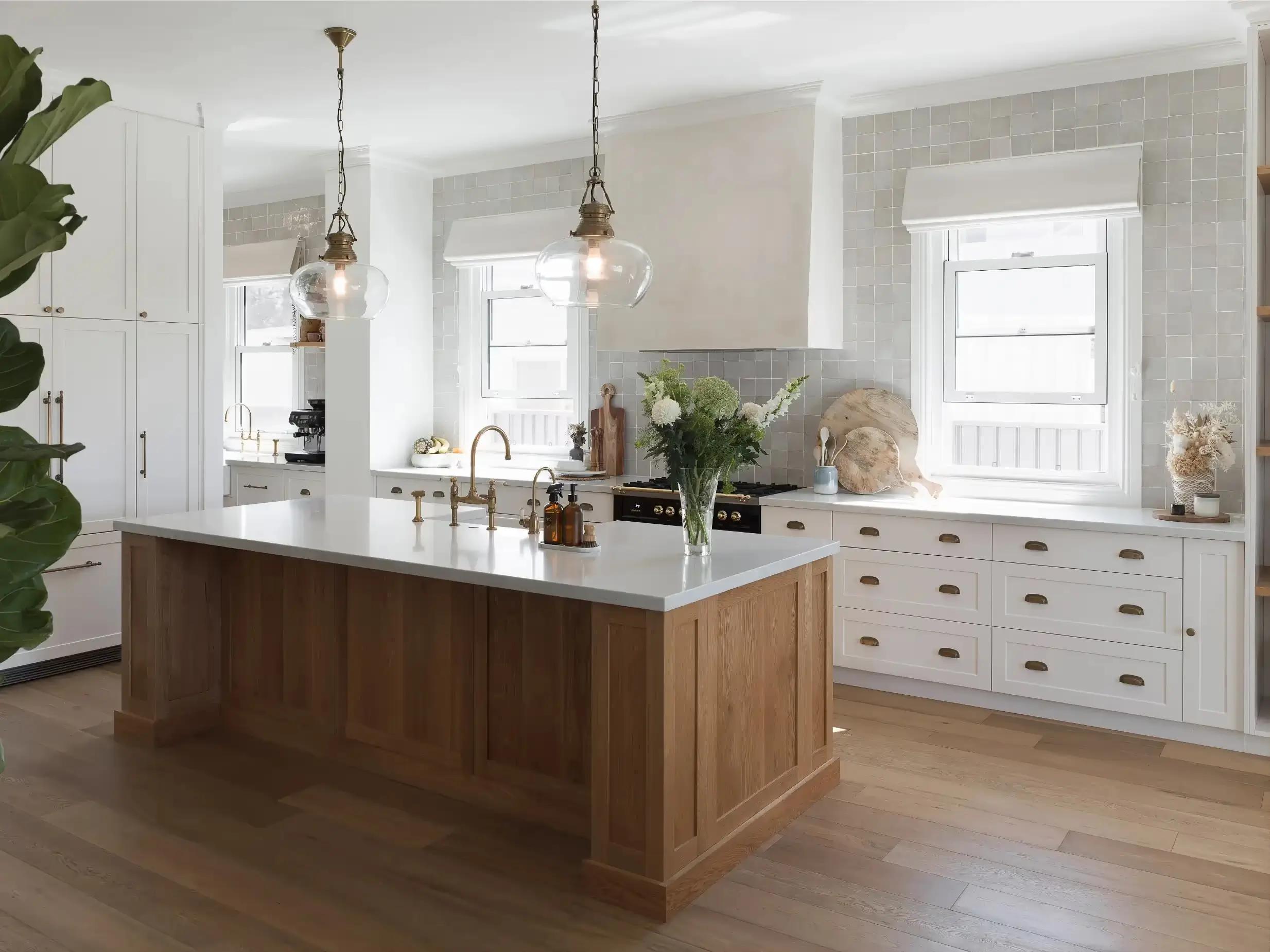
This is where personal taste turns directly into dollars, and it is the easiest area to overspend without a plan. The gap between laminate benchtops and engineered stone or natural marble can be tens of thousands of dollars on its own.
The same pattern runs through the rest of the house. Engineered timber, polished concrete or large-format tiles carry a premium over carpet and vinyl on every square metre. Thermally broken frames, double glazing and custom timber pivot doors lift the window and door budget noticeably, though the glazing also earns some of it back in running costs. European tapware and light fittings sit well above builder's range equivalents. None of this is an argument for the cheaper option. It is an argument for choosing the three or four places where the upgrade actually shows, and being ordinary everywhere else.
Is It Cheaper to Knock Down and Rebuild or Renovate in Brisbane?
Both are real options and Invilla designs both. Which one suits comes down to what you are trying to keep.
A renovation keeps what is already there: the character of an older Brisbane home, a mature garden, the parts of the plan that already work. It usually starts at a lower number and can be staged across a few years.
A rebuild starts from the block rather than the building. The plan is shaped around orientation, breezes and how your family actually lives, built to current codes throughout, under one warranty.
The variable that usually decides it is condition. The more of the existing structure your design depends on, the more an inspection matters before anything is drawn. That inspection is what tells you which of these two conversations you are actually having.
| Factor | Knock down rebuild | Major renovation |
|---|---|---|
| Design freedom | Complete, shaped around the block | Works within the existing structure |
| Character retained | New from the ground up | Keeps the original street presence and detail |
| Entry cost | Higher upfront | Usually lower to start, and can be staged |
| Cost predictability | Firmer once documented | Depends on what condition assessment finds |
| Timeline | 12 to 18 months, fairly predictable | Varies with scope, often shorter |
| Energy performance | Current NCC standards throughout | Improved in the areas being reworked |
| Warranty | New home warranty across the whole house | Covers the new work |
If you are still weighing the two options, our full knock down rebuild vs renovation guide works through the decision in more depth, including when a renovation genuinely is the smarter call.
Why Rebuild Instead of Moving?
Moving gets you a different house and a different street. For a lot of Brisbane owners the street is the part worth keeping, and the house is the part that stopped working.
Rebuilding keeps the address and starts the house again. Because you already live there, you know things a buyer never will: where the afternoon sun lands, which rooms cop the westerly, where the breeze actually comes through in February. That knowledge goes straight into the design instead of being guessed at.
There is a practical side as well. Selling and buying carries agent fees, stamp duty and the cost of the move itself, none of which ends up in the house you live in.
It is the thinking behind a line we use with clients: reimagine your home, not your address.

How Long Does a Knock Down Rebuild Take in Brisbane?
A realistic timeframe for a knock down rebuild in Brisbane is 12 to 18 months from first design sketches to keys in hand. Pre-construction typically takes 4 to 6 months, demolition and site preparation take 2 to 4 weeks once approvals are in place, and construction usually runs 8 to 12 months depending on size and complexity.
The three stages, and what each one is actually waiting on:
- Pre-construction (4 to 6 months): the planning phase, where the architectural design is developed, engineering is locked in, material selections are made and the plans move through the approval process.
- Demolition and site preparation (2 to 4 weeks): the old house comes down, the site is cleared and the block is prepared for the new build.
- Construction (8 to 12 months): the longest stretch.
Council processing times, your builder’s schedule and major weather events can all shift the timeline, but the 12 to 18 month window is a solid benchmark to plan around, including for your temporary accommodation budget.
Do You Need Council Approval for a Knock Down Rebuild in Brisbane?
Yes. Every knock down rebuild needs demolition approval to legally remove the existing house, and building approval for the new home, assessed by a private certifier against the National Construction Code. Some blocks also need a separate development approval through Brisbane City Council first, usually triggered by overlays such as character residential zoning, flood risk or small-lot constraints.
The three approvals work like this:
- Demolition approval: the official green light to take down the existing house, with checks covering asbestos management and safe removal of the old structure.
- Building approval (BA): the technical sign-off on your new home’s design, where a private certifier confirms the plans comply with the National Construction Code and relevant Queensland standards.
- Development approval (DA): a separate approval that some properties need before a BA can be applied for, typically where Brisbane City Council overlays apply, such as character residential zones, flood-prone areas or other constraints on the block.
Your design team prepares and submits these applications for you, and advises whether your block can proceed through faster private certification or needs the council DA pathway first.
Beyond approvals, the sequence stays consistent on every site: feasibility, design and documentation, approvals, demolition, construction, handover. The early stages carry the most leverage, because a decision made on paper costs a fraction of the same decision made on site. Our full walkthrough of the knock down rebuild process covers who is responsible at each stage.
Hidden Costs and How to Control Your Budget
Even with complete documentation, a site can still surprise you once machinery is on it, and some costs only appear when council attaches a condition to the approval. This is what the 10 to 20 percent contingency is for. Spent, it absorbs the surprise. Unspent, it comes back to you at the end.
Common unforeseen on-site costs include hitting rock during excavation, which brings in rock breakers at significant hourly cost; retaining walls that only become obviously necessary once the site is cleared; and council-required upgrades to public infrastructure, such as new stormwater connections or footpath repairs, as a condition of approval.
Remember too that the builder’s fixed-price contract rarely covers everything you need to actually live in the house. Budget separately for post-handover items:
- Landscaping: turf, garden beds, plants and irrigation.
- Driveways and paths: almost always a separate cost.
- Fencing: new boundary fences to secure the property.
- Window coverings: blinds, curtains and shutters for privacy.
- Small essentials: the mailbox and clothesline usually fall to the owner after handover.
Cost control is mostly won before construction starts. Finalising every selection before the builder is on site, from tapware and tiles down to paint colours and power point locations, removes the mid-build variations where budgets and timelines usually slip.
Complete documentation also makes fixed-price quotes comparable, because every builder is pricing the same scope instead of filling the gaps with their own assumptions.
And not everything has to happen at handover. Plenty of clients finish the basics, move in, then add the deck, the pool or the planting a year or two on.
Working Out Your Own Number
Every figure in this guide is a range, because that is all a general guide can honestly give you. Your number depends on your block, your brief and the level of finish you are after.
The estimator narrows it. A few minutes returns a genuine quote range drawn from the homes we have designed and documented, which is enough to know whether a rebuild is the conversation you should be having at all.