

When designing and building in a flood or overland flow area, no house is ever completely flood-proof. The realistic and far more valuable goal is a flood-resilient home: one designed so that, when water does come, it resists serious damage and recovers quickly. In practice that comes down to four things, understanding exactly how your site floods, lifting the living spaces above the flood level, building the parts that may get wet from materials that shrug off water, and keeping the home's services up out of harm's way. Get those right and you have a home that protects both your family and your investment.
I'm Michael Johnston, a registered architect and director at Invilla. We design homes across Brisbane, much of it in flood-aware country, so here's the plain-English version of how flood-resilient design actually works.
Resilience protects more than the building
In a flood-prone area, the risk doesn't only show up as repair bills after a storm. It shows up quietly in insurance premiums and in resale value, because insurers and the market both price in flood risk. The encouraging part is that a home with a documented, well-designed resilience strategy holds its value and its insurability far better than an identical house with no protection. Designing for water is a financial decision as much as a structural one.
Start with the site, not the floor plan
A resilient home begins with understanding the land and its associated habitable floor levels, not choosing materials or internal features. Before any design, we work out not just whether a site floods, but how, how often, and to what depth.
The first port of call is your council. Brisbane City Council, like most at-risk councils, publishes flood mapping that shows overland flow paths and riverine inundation. Where a flood overlay applies, it sets a defined flood level for your site and a minimum habitable floor level, the height your living floors must meet or exceed, usually with a freeboard (a safety margin) on top. That isn't advice, it's a planning requirement that directly shapes the home's form. When a site is impacted, we work with our specialist consultant team, in this case a hydraulic engineer, to determine the requirements to achieve flood immunity.
For broader context, the Australian Flood Risk Information Portal, maintained by Geoscience Australia, catalogues flood studies and maps from across the country. It's a historical record of studies completed up to 2018, useful for seeing what formal flood investigations already exist for an area.
Then there's the site itself: the natural fall of the land and where water wants to pool or flow, the existing stormwater drainage, and what the neighbours are doing, since a new wall, paved area or extension next door can change how water moves onto your block. Flood risk is never static, so a proper assessment considers the whole local catchment, not just your boundaries.
Reading those layers together is the first thing our Brisbane architecture practice does on any flood-tagged site, well before the first sketch.
Two approaches: dry-proofing and wet-proofing
Flood-resilient design works in two ways, and most good homes use a combination. Dry-proofing keeps water out entirely, through elevation or impermeable barriers. Wet-proofing accepts that water may enter certain areas and designs them to take it and dry out fast with minimal damage. Your site's risk profile decides the mix.
Elevating the living spaces
The single most effective move is elevation, lifting the main living areas above the defined flood level. It doesn't have to look like a house on stilts:
- Raising on fill or a raised slab lifts the habitable floors while keeping a grounded, solid look. It suits sites with lower to moderate risk.
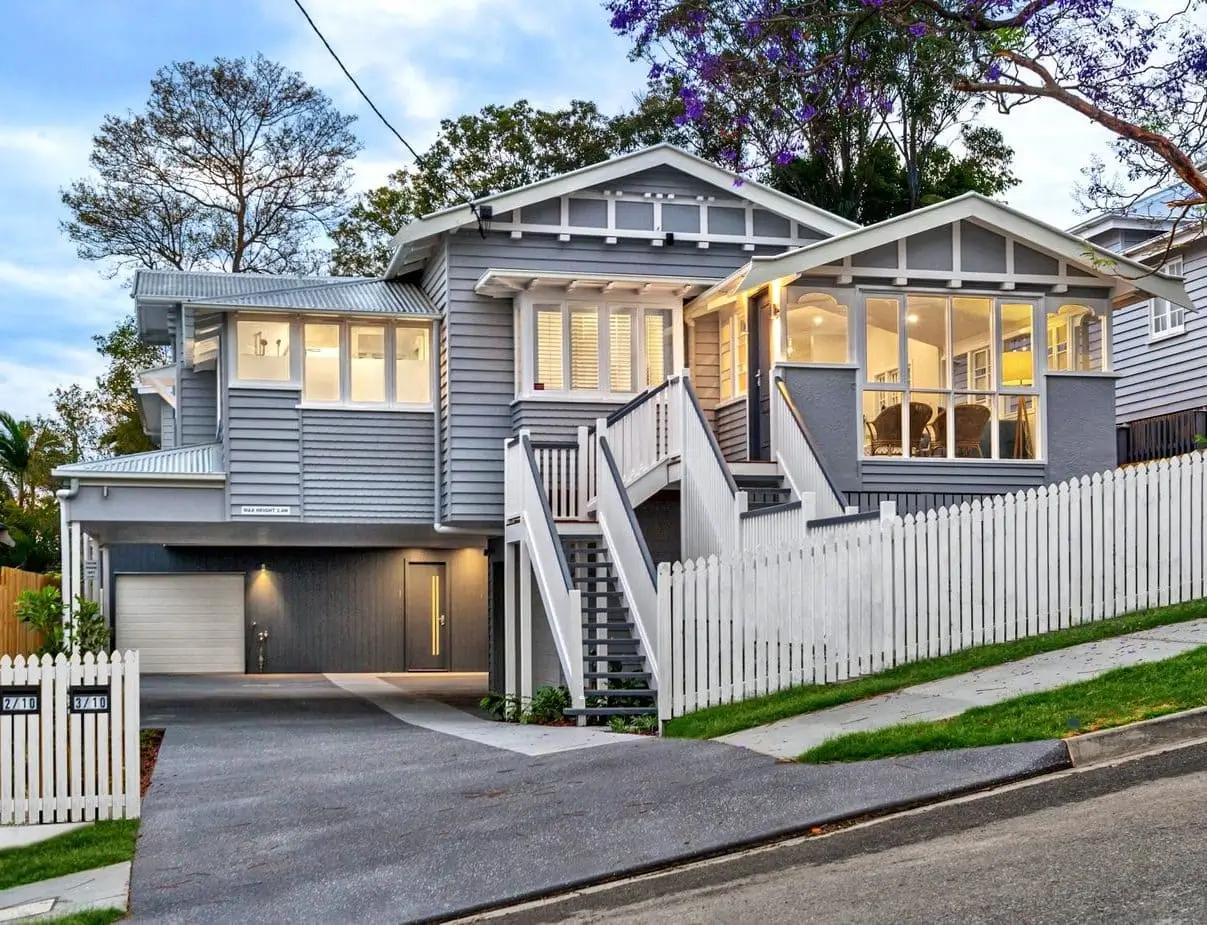
- Piers or stumps raise the home and let floodwater pass underneath, easing the pressure that can damage foundation walls. It suits higher-velocity flow, and it's exactly the logic behind the classic high-set Queenslander.
Raising an existing home onto a new, compliant lower level is its own substantial project. We cover it in detail in our guide to raising a Queenslander and building underneath.
A sacrificial lower level
Where full elevation isn't practical, on a tight block or a knock-down-rebuild, you can wet-proof a sacrificial lower level: a non-habitable ground floor for parking, storage or a hardy rumpus, designed to take water and recover. The essentials:
- Robust materials that wet and dry without falling apart, core-filled blockwork or off-form concrete rather than plasterboard.
- Durable flooring such as polished concrete or heavy tiles, in lieu of more flood-susceptible materials such as timber or carpet.
- Flood vents built into the walls to let water in and out and equalise pressure, with the floor graded to drains for a fast clean-up.
- Elevated services, switchboard, power points and hot water kept well above the expected flood height.
This protects the living spaces above and turns a ground-floor flood into a clean-up rather than a rebuild.
Materials that stand up to water
Standard plasterboard, untreated timber and fibreglass insulation act like sponges. The resilient alternatives cost little more and change the recovery entirely. The same discipline of durable, considered material selection runs through any high-end build, more on that in our guide to selecting the right materials for luxury home design.
Component | Standard | Flood-resilient alternative | Why it matters |
|---|---|---|---|
Flooring | Carpet, laminate, timber | Polished concrete, ceramic or porcelain tile | Impervious to water, easy to sanitise |
Wall linings | Plasterboard | Fibre cement sheet, concrete blockwork | Won't swell or degrade when wet |
Insulation | Fibreglass batts | Closed-cell spray foam, rigid foam board | Doesn't absorb water or grow mould |
Joinery | MDF, particleboard | Marine plywood, solid timber, PVC | Resists swelling and delamination |
Electrical | Standard-height outlets | Elevated outlets and switchboard | Keeps services above the flood level |
Plumbing | Standard sewer connection | Backflow prevention valve | Stops contaminated water backing up |
Working with the landscape
Your first line of defence starts at the boundary. Grading the ground to fall away from the house, shaping shallow vegetated swales and rain gardens to slow and soak up runoff, and using permeable paving instead of large slabs of concrete all reduce the volume and speed of water reaching the home. Done well, the garden becomes part of the drainage system rather than adding to the problem.
Frequently asked questions
How much more does a flood-resilient home cost? It depends entirely on what your site needs. A low-risk block might only need resilient ground-floor materials and raised services; a high-velocity zone may call for the whole home to be elevated on piers. The only way to a real figure is a feasibility look at your specific site.
Will it lower my insurance? Generally, yes. Insurers price on risk, so documented resilience, living areas above the defined flood level, elevated services, and a registered surveyor's survey of your floor levels, gives them a measurable reduction to price against. It's worth discussing with your insurer early in the design.
Do I need a survey of my floor levels? In a designated flood area, yes. A registered surveyor can certify your floor levels relative to the defined flood level. Councils require it to confirm a build meets the minimum habitable floor level, and insurers use it to set accurate premiums rather than worst-case estimates.
Can an existing home be retrofitted? Yes, and it's common. The main approaches are raising the house onto a new compliant level, wet-proofing a lower level with water-resistant materials and elevated services, and dry-proofing with membranes and barriers. An architect can assess your home and recommend the most practical, cost-effective path.
We design homes across Brisbane and the Sunshine Coast that are built to be both beautiful and resilient. Start your project with our Quote Estimator and we'll talk through what's realistic for your site.